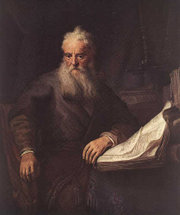
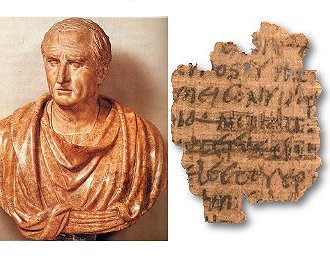
Many people, including me, think that 1 Corinthians 13 is one of the most remarkable things ever written. Although some scholars argue that Paul replaced the message of Jesus with one of his own devising, I think that this passage demonstrates otherwise. Like the rest of the New Testament, the oldest manuscripts are in Greek, and it is probable that Paul originally wrote (or more likely dictated) it in Greek. Notice the differences in the following two translations:
King James Version
1 Though I speak with the tongues of men and of angels, and have not charity, I am become as sounding brass, or a tinkling cymbal.
2 And though I have the gift of prophecy, and understand all mysteries, and all knowledge; and though I have all faith, so that I could remove mountains, and have not charity, I am nothing.
3 And though I bestow all my goods to feed the poor, and though I give my body to be burned, and have not charity, it profiteth me nothing.
4 Charity suffereth long, and is kind; charity envieth not; charity vaunteth not itself, is not puffed up,
5 Doth not behave itself unseemly, seeketh not her own, is not easily provoked, thinketh no evil;
6 Rejoiceth not in iniquity, but rejoiceth in the truth;
7 Beareth all things, believeth all things, hopeth all things, endureth all things.
8 Charity never faileth: but whether there be prophecies, they shall fail; whether there be tongues, they shall cease; whether there be knowledge, it shall vanish away.
9 For we know in part, and we prophesy in part.
10 But when that which is perfect is come, then that which is in part shall be done away.
11 When I was a child, I spake as a child, I understood as a child, I thought as a child: but when I became a man, I put away childish things.
12 For now we see through a glass, darkly; but then face to face: now I know in part; but then shall I know even as also I am known.
13 And now abideth faith, hope, charity, these three; but the greatest of these is charity.
New King James Version
1 Though I speak with the tongues of men and of angels, but have not love, I have become sounding brass or a clanging cymbal.
2 And though I have the gift of prophecy, and understand all mysteries and all knowledge, and though I have all faith, so that I could remove mountains, but have not love, I am nothing.
3 And though I bestow all my goods to feed the poor, and though I give my body to be burned, but have not love, it profits me nothing.
4 Love suffers long and is kind; love does not envy; love does not parade itself, is not puffed up;
5 does not behave rudely, does not seek its own, is not provoked, thinks no evil;
6 does not rejoice in iniquity, but rejoices in the truth;
7 bears all things, believes all things, hopes all things, endures all things.
8 Love never fails. But whether there are prophecies, they will fail; whether there are tongues, they will cease; whether there is knowledge, it will vanish away.
9 For we know in part and we prophesy in part.
10 But when that which is perfect has come, then that which is in part will be done away.
11 When I was a child, I spoke as a child, I understood as a child, I thought as a child; but when I became a man, I put away childish things.
12 For now we see in a mirror, dimly, but then face to face. Now I know in part, but then I shall know just as I also am known.
13 And now abide faith, hope, love, these three; but the greatest of these is love.
The word that is translated as “charity” in the KJV and as “love” in the NKJV version and most other modern English translations is the Greek word “agape” (agape). The NKJV version is probably more accurate. C. S. Lewis had a fine lecture called “The Four Loves,” in which he discussed the Greek words storge, philia, eros, and agape (roughly affection, friendship, erotic love, and divine love). If anyone is interested, I may be able to put it on CD for you. I warn you that his view of homosexual love is not enlightened by current standards.